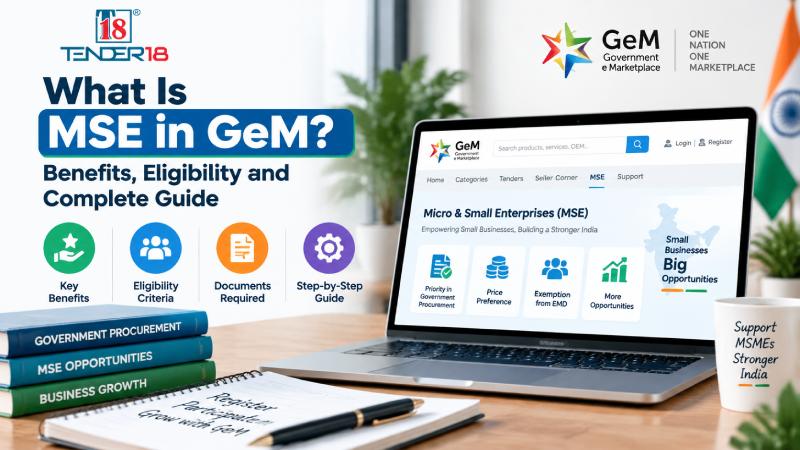
The Government e-Marketplace (GeM) provides opportunities for businesses of different sizes to sell products and services to government buyers. Among these sellers, Micro and Small Enterprises (MSEs) receive certain benefits under government procurement policies.
Understanding what is MSE in GeM helps small businesses learn how they can participate in government procurement, what eligibility requirements apply, and how MSE benefits work while bidding on the platform.
This guide explains the meaning of MSE in GeM, eligibility criteria, benefits, purchase preference rules, and important points sellers should know.
MSE stands for Micro and Small Enterprises.
On the GeM portal, MSE refers to businesses that fall under the Micro and Small Enterprise categories according to government classification guidelines.
These businesses can register on GeM and participate in government procurement opportunities by offering their products and services to different government organisations.
MSE sellers may receive certain advantages during procurement processes, including purchase preference benefits where applicable.
Many sellers use the terms MSE and MSME interchangeably, but they have different meanings.
MSME stands for:
Micro, Small and Medium Enterprises
It includes:
MSE specifically refers to:
| Category | Meaning |
| MSME | Includes Micro, Small and Medium Enterprises |
| MSE | Includes Micro and Small Enterprises only |
A business must meet government classification criteria to qualify under these categories.
Businesses that qualify as Micro or Small Enterprises can register as sellers on GeM.
Common requirements include:
Before selling on the platform, businesses should complete the required registration process. New sellers can understand the steps through the GeM registration process.
MSE sellers can access several opportunities through government procurement.
GeM connects businesses with government departments, public sector organisations, and other eligible buyers.
This allows small businesses to present their products and services to a wider customer base.
Government procurement policies provide certain purchase preference benefits to eligible MSE sellers.
Under applicable rules, MSE sellers may receive preference during procurement processes if they meet the required conditions.
The preference depends on factors such as:
MSE businesses can participate in various procurement opportunities available through GeM.
Sellers can search for suitable requirements based on:
Businesses looking for relevant opportunities can explore available government tender opportunities according to their industry.
Government procurement can help small businesses reach buyers beyond their local market.
Through GeM, sellers can showcase their products and compete with other suppliers based on requirements and pricing.
MSE purchase preference allows eligible Micro and Small Enterprises to receive certain advantages during government procurement.
However, preference is not automatic for every bid.
A seller must:
The buyer evaluates bids according to the applicable procurement rules.
MSE sellers can participate in bids by following these general steps:
Create and verify your seller account on GeM.
Upload accurate product details, specifications, and required information.
Search for opportunities that match your business category.
Review all requirements and submit documents before the deadline.
Understanding the complete GeM bidding process helps sellers prepare better submissions and avoid common mistakes.
The required documents may vary depending on the business type and procurement requirement.
Common documents include:
Sellers should always review the specific requirements mentioned in each bid.
Ensure that registration details match official documents.
Incorrect information may create verification issues.
Incomplete documentation can affect bid eligibility.
Always check the bid requirements before submission.
Choosing the wrong category can reduce visibility and affect participation opportunities.
Businesses should keep important information updated, including registration and certification details.
Both MSE and regular sellers can participate in government procurement.
The difference is that eligible MSE sellers may receive specific benefits under procurement policies.
| MSE Sellers | Regular Sellers |
| Eligible for MSE-related benefits | Participate under general rules |
| Need valid MSE classification | Follow standard seller requirements |
| May receive purchase preference where applicable | Compete based on general criteria |
Finding suitable government opportunities requires regular monitoring and understanding of procurement requirements.
Tender18 helps businesses access tender-related information and identify opportunities relevant to their industry.
Businesses that require professional support with tender preparation, documentation, and submission can explore tender bidding services based on their requirements.
MSE sellers play an important role in government procurement through the GeM platform. Understanding MSE eligibility, benefits, and bidding requirements helps small businesses participate more effectively.
By maintaining accurate business information, following bid requirements, and regularly monitoring opportunities, Micro and Small Enterprises can improve their participation in government procurement.
Looking For Complete Tender Bidding Consultancy? Our Technical Experts Will Help You Prepare And Submit Your Tender Successfully.