
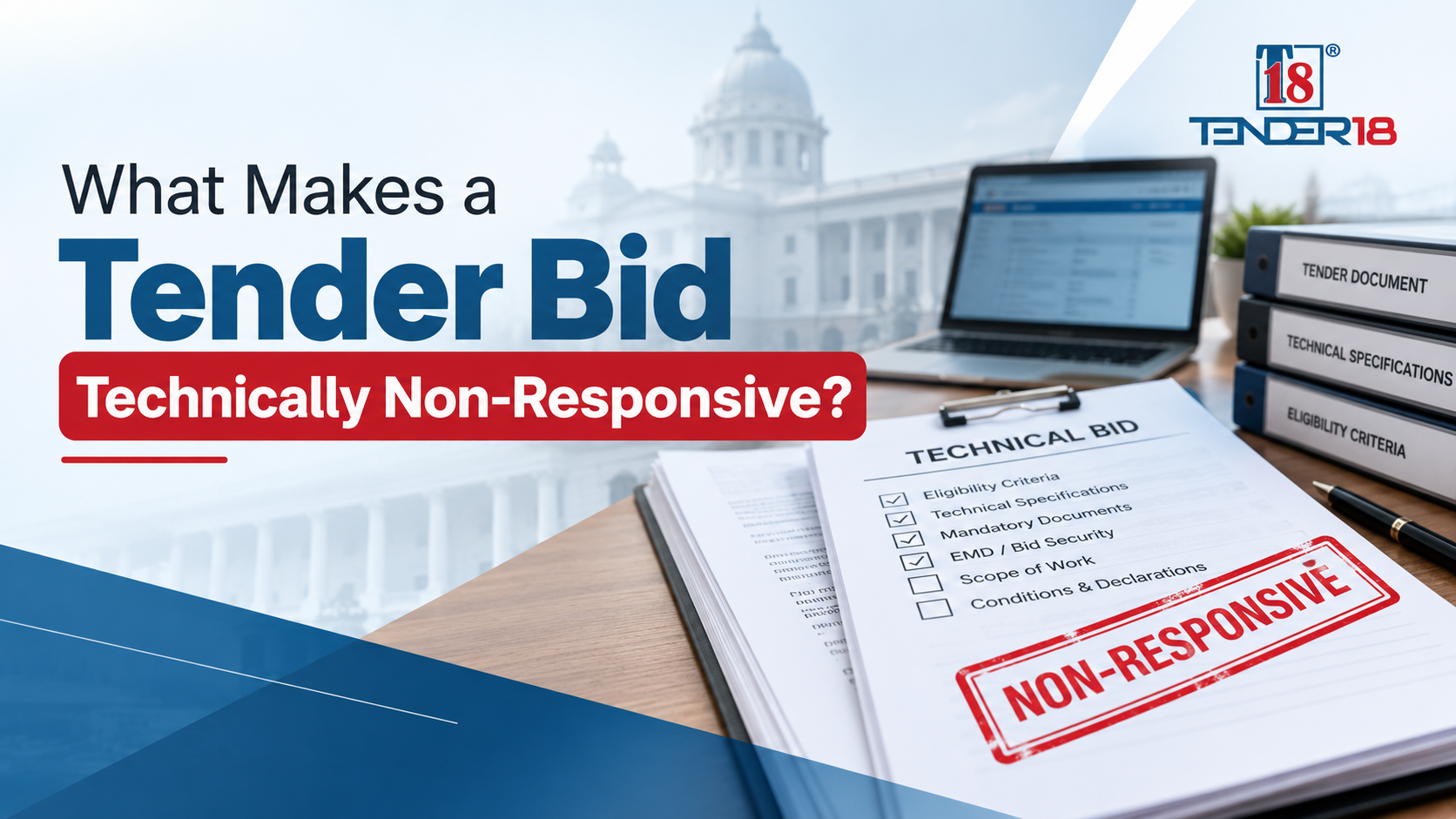
A tender bid may be considered technically non-responsive when it fails to meet an essential requirement of the tender document or contains a substantive deviation, reservation or omission.
In simple terms, the bidder has submitted an offer that does not comply with an important condition of the tender.
However, not every small mistake automatically makes a bid non-responsive. The seriousness of an issue depends on the tender conditions, the nature of the requirement and the applicable procurement rules. The Department of Expenditure's Manual for Procurement of Works, Second Edition, 2025 explains responsiveness in terms of conformity with the essential requirements of the tender without substantive deviation, reservation or omission. Department of Expenditure — Manual for Procurement of Works
A technically responsive bid generally meets the essential requirements specified by the procuring authority.
These requirements can include:
A bid can become non-responsive when it fails to satisfy an important requirement or contains a substantive deviation from what the tender asks for.
If a tender requires:
Supply + Installation + Commissioning
but the bidder offers:
Supply only
the bid may have a substantive deviation because an important part of the required scope has been left out.
Every tender has its own eligibility conditions.
These may include:
If a bidder does not satisfy an essential eligibility condition, the bid may be treated as non-responsive.
What to do: Check the eligibility section before spending time preparing the complete bid.
A tender may require specific documents, declarations, certificates or forms.
For example:
Missing an important stipulated document can create a compliance problem.
However, not every missing document automatically has the same consequence. Some minor or pre-existing documentary shortfalls may be handled according to the tender conditions and applicable procurement rules.
If a tender requires an Earnest Money Deposit (EMD), the bidder must follow the specified amount, method and other conditions.
Problems can arise when:
If an EMD exemption is available, don't assume that every MSME or other registration automatically qualifies. Check the specific tender and applicable exemption rules.
A bidder must carefully compare the offered product, service or solution with the tender's technical requirements.
For example:
Tender requires:
500 units/hour capacity
Bid offers:
300 units/hour capacity
If the requirement is essential, this difference could make the bid technically non-compliant.
Don't compare only product names or model numbers. Check the actual:
A tender may contain several activities under one scope.
For example:
Supply + Installation + Testing + Commissioning
If a bidder quotes only for supply, the offer may not satisfy the complete requirement.
The Department of Expenditure's procurement manual specifically identifies failure to quote for the entire required scope as a circumstance that can make a bid unresponsive.
Always read the complete scope of work instead of judging a tender only from its title.
A bidder may unintentionally add conditions that conflict with the tender.
For example:
“Delivery is subject to advance payment.”
If such a condition isn't permitted by the tender, it can create a compliance issue.
Bid validity is another important requirement. If the tender requires a 120-day validity period but the bidder offers a shorter period without an allowed exception, the bid may be considered non-responsive.
A substantive deviation is more serious than a minor formatting or clerical mistake.
It can involve a deviation that materially affects:
For example:
Tender: 100 machines with a specified warranty and installation
Bid: 100 machines without the required installation
The difference changes an important part of the bidder's obligation and therefore needs to be treated differently from a simple typing error.
No.
This is an important distinction.
A minor clerical error or document issue may not necessarily have the same consequence as failing to meet an essential technical or eligibility requirement.
The applicable procurement framework can allow certain minor infirmities or clarifications, depending on the circumstances. However, clarification should not be treated as an opportunity to fundamentally change the bid or gain an unfair advantage.
So don't follow either of these assumptions:
“Any mistake means automatic rejection.”
or
“I can fix anything after submitting.”
Both can be wrong.
Always check the specific tender conditions.
Imagine a tender requires:
| Bidder | Issue | Possible concern |
|---|---|---|
| A | Meets all requirements | No obvious substantive issue |
| B | Offers 1-year warranty | Potential technical deviation |
| C | Claims EMD exemption | Exemption must be valid and supported |
| D | Minor typing error | May be minor if it doesn't affect the bid |
The important lesson is:
Don't look only for mistakes. Look at whether the mistake affects an essential requirement of the tender.
Use this checklist before the final submission.
The government eProcurement portal specifically instructs bidders to review the latest tender information and corrigenda before submission. It also states that a bid must be successfully frozen to complete the online submission. Government eProcurement System — Help for Contractors
The exact process depends on the tender's evaluation method.
In procurement processes where technical responsiveness is assessed before financial evaluation, bids that fail the required responsiveness check generally do not proceed to the next evaluation stage. Substantively responsive bids can then proceed according to the tender's evaluation procedure.
This is why being the lowest bidder does not by itself solve a technical compliance problem.
Don't assume that it can.
Depending on the procurement rules and tender conditions, the procuring authority may seek clarification about certain minor issues or documents that already existed before the bid deadline.
However, clarification is not the same as changing the substance of the bid.
A bidder should therefore prepare the submission as if every mandatory requirement needs to be correctly satisfied before the deadline.
Looking For Complete Tender Bidding Consultancy? Our Technical Experts Will Help You Prepare And Submit Your Tender Successfully.