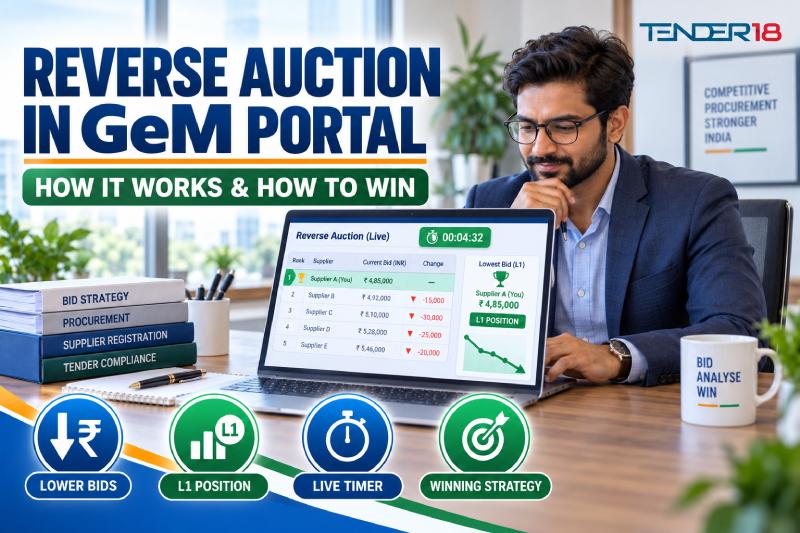
Understanding reverse auction in GeM is important for businesses that want to participate in government procurement opportunities through the Government e-Marketplace. Unlike traditional auctions where buyers compete by increasing prices, a reverse auction allows sellers to compete by reducing their prices to offer the best possible deal to the buyer.
The GeM reverse auction process helps government buyers select suitable sellers through a transparent online bidding system. Sellers can participate in these auctions, compete with other suppliers, and improve their chances of receiving government purchase orders by following the right bidding strategy.
For new sellers, understanding GeM RA bidding, L1 bidding, bid decrement rules, auto extension, and pricing strategy is essential before participating in reverse auctions.
This guide explains how reverse auction works on the GeM portal, how sellers can participate, what factors influence winning bids, and how businesses can improve their chances of success.
A reverse auction in GeM portal is an online bidding process where sellers compete against each other by offering lower prices for a product or service required by a government buyer.
In a normal auction:
In a reverse auction:
The main purpose of a reverse auction is to help government buyers receive competitive pricing while maintaining transparency in the procurement process.
On GeM, reverse auctions are conducted digitally, allowing eligible sellers to submit their bids online within a specified time period.
The GeM reverse auction process involves several stages, starting from buyer requirement creation to final seller selection.
The process begins when a government buyer identifies a requirement for a product or service.
The buyer defines details such as:
Only sellers who meet the specified requirements can participate in the reverse auction.
After the reverse auction is published, eligible sellers can review the requirements and decide whether to participate.
Before submitting a bid, sellers should carefully check:
Participating without understanding the requirements can lead to unsuccessful bids or order fulfillment issues.
Businesses that want to understand the overall GeM bidding process can also refer to our guide on How to Participate in GeM Bids.
During the reverse auction, sellers compete by reducing their prices.
The bidding process allows sellers to submit lower offers according to the bid rules.
Important factors include:
A seller should not reduce prices without calculating actual costs because winning an order at an unsustainable price can affect profitability.
After the auction ends, the buyer evaluates the submitted offers.
Although price is an important factor, sellers must also meet:
A seller offering the lowest price but failing technical requirements may not be selected.
After evaluation, the selected seller receives the purchase order according to GeM procedures.
The seller then needs to complete:
Timely fulfillment helps maintain seller performance on the platform.
The GeM RA bidding process follows a structured online system where sellers compete through price-based bidding.
RA stands for Reverse Auction.
The process generally includes:
The objective is to create a transparent environment where government buyers can compare competitive offers from eligible sellers.
L1 means Lowest One or the lowest-priced bidder.
In GeM reverse auctions, the seller with the lowest acceptable bid price is generally ranked as L1.
However, becoming L1 does not only depend on offering the lowest price. The seller must also satisfy the required technical and eligibility conditions.
For example:
Seller A:
Seller B:
In such a situation, the lowest price alone may not guarantee selection.
Sellers should focus on maintaining:
Bid decrement refers to the minimum amount by which a seller must reduce their price during a reverse auction.
For example:
Current lowest bid:
₹1,00,000
Bid decrement:
₹2,000
The next acceptable bid may need to be:
₹98,000 or lower
The bid decrement value controls how sellers can reduce prices during the auction.
A smaller decrement allows gradual price competition, while a larger decrement creates faster price movement.
Auto extension is a feature designed to provide fair opportunities to participating sellers.
If a seller submits a bid near the end of the auction period, the system may automatically extend the auction time according to the applicable rules.
The purpose of auto extension is to:
Sellers participating in reverse auctions should monitor the auction until completion because the closing time may change due to auto extension rules.
Government procurement can happen through different methods, and sellers should understand the difference between a traditional tender process and a GeM reverse auction before participating.
Both methods aim to help government buyers select suitable suppliers, but the bidding approach is different.
| Reverse Auction on GeM | Normal Tender Process |
| Sellers compete by reducing prices | Sellers usually submit a fixed quotation |
| Price competition happens online in real time | Offers are evaluated after submission |
| Sellers can see ranking changes during bidding | Sellers usually cannot see competitor pricing |
| L1 ranking is important | Technical and financial evaluation both play a role |
| Faster price-based competition | More detailed evaluation process |
A reverse auction focuses heavily on competitive pricing, while a normal tender may involve broader evaluation factors such as technical capability, experience, quality requirements, and financial terms.
Sellers should understand the auction format before participating because the bidding strategy for both processes is different.
Winning a reverse auction bid on GeM requires more than simply offering the lowest price. Successful sellers combine proper preparation, cost analysis, product understanding, and competitive bidding techniques.
Below are some strategies that can help businesses improve their chances during GeM RA bidding.
Before entering a reverse auction, sellers should calculate their actual cost structure.
Consider:
Many sellers make the mistake of reducing prices without understanding whether the final amount remains profitable.
A successful bid should be competitive while still allowing the business to fulfill the order properly.
Understanding market trends helps sellers decide their bidding approach.
Before participating, research:
This helps sellers create a realistic minimum price.
A seller who enters a reverse auction without pricing research may either bid too high and lose the opportunity or bid too low and affect profitability.
A common mistake during reverse auctions is continuously lowering prices because of competition.
Before bidding starts, decide:
Having a predefined limit prevents emotional bidding decisions.
GeM reverse auctions happen online, so sellers should actively monitor bidding activity.
During the auction, pay attention to:
Quick decisions during live bidding can improve the chances of achieving a better position.
Price is important, but sellers must also meet all technical requirements.
A lower price does not help if the product fails to satisfy:
Before participating, sellers should confirm that their product matches the buyer's requirements.
A professional seller profile improves buyer confidence.
Sellers should maintain updated information such as:
Businesses that are new to the platform should first understand the complete seller process. A proper seller account setup is explained in our guide on How to Sell on GeM.
A planned approach can help sellers participate more effectively in competitive bidding.
The goal of reverse auction is not always to become the cheapest seller at any cost.
A seller should consider:
A very low price can create challenges during order fulfillment.
Not every auction is suitable for every seller.
Before participating, check:
Participating in unsuitable auctions wastes time and resources.
Delays often happen because sellers do not have required documents ready.
Keep updated:
Proper preparation helps avoid last-minute problems.
During reverse auctions, sellers can learn from bidding patterns.
Observe:
This information can help create better strategies for future auctions.
Winning one auction is not the only goal. Sellers should also focus on maintaining good performance after receiving orders.
Important factors include:
Good performance can support future business opportunities.
Many sellers lose opportunities because of avoidable mistakes.
Some sellers participate only because the product category appears relevant.
Before bidding, carefully review:
A bid should be submitted only when the seller can successfully fulfill the order.
Although L1 ranking is important, price is not the only consideration.
Sellers should ensure:
A low price without proper compliance can create problems.
GeM auctions have specific timelines.
Missing:
can result in losing opportunities.
Aggressive price reduction without calculation can create losses.
Before entering the auction, sellers should know their minimum acceptable price.
Incomplete product information can reduce buyer confidence.
Sellers should maintain:
Reverse auctions provide several advantages for eligible sellers.
Businesses can reach government organizations looking for specific products and services.
The online bidding system creates a structured environment where sellers can participate fairly.
Reverse auctions allow sellers to compete for government orders beyond their local market.
Regular participation helps sellers understand:
Participating in GeM reverse auctions requires understanding bidding rules, pricing strategies, documentation, and marketplace procedures.
Tender18 provides GeM Bidding Support to help businesses manage their government procurement journey more effectively.
Support can include:
For businesses new to government procurement, professional guidance can help reduce common mistakes and improve the bidding process.
The reverse auction in GeM portal provides businesses with an opportunity to compete for government orders through a transparent online bidding system. Understanding the GeM reverse auction process, L1 bidding, bid decrement, auto extension, and pricing strategy is important for sellers who want to participate successfully.
Winning a GeM reverse auction is not only about offering the lowest price. Successful sellers focus on proper cost calculation, product quality, documentation, and a well-planned bidding approach.
Businesses that prepare properly and understand the bidding process can use GeM reverse auctions as an effective way to expand their government procurement opportunities. With professional GeM Bidding Support, sellers can better understand requirements, avoid common mistakes, and participate more confidently in government tenders.
Looking For Complete Tender Bidding Consultancy? Our Technical Experts Will Help You Prepare And Submit Your Tender Successfully.