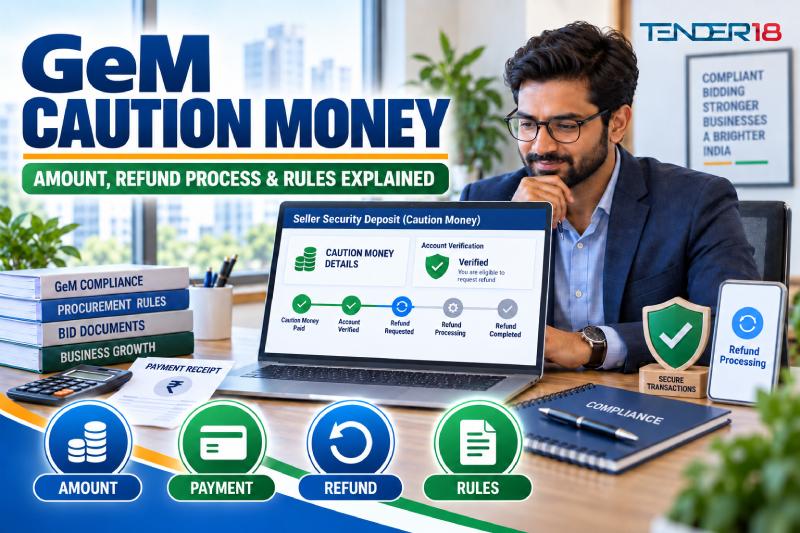
GeM caution money is a topic that can be confusing for sellers because much of the information available online refers to older GeM rules. Earlier, sellers were required to maintain a one-time caution money deposit based on their turnover. That requirement has now been discontinued for sellers and service providers. GeM's latest policy position removes the caution money requirement, while sellers who had already deposited the amount can withdraw it through the GeM caution money facility.
This change is important for anyone researching the GeM caution money amount, registration requirements, or refund process in 2026. Older documents and articles may still show turnover-based caution money slabs, but those figures describe the earlier system.
In this guide, we explain what GeM caution money was, why it was introduced, what changed, whether new sellers need to pay it, and what existing sellers should know about withdrawing an old deposit.
GeM caution money was a one-time financial deposit associated with seller participation on the Government e-Marketplace.
Under the earlier system, sellers deposited caution money according to their turnover. The deposit was separate from other procurement-related financial requirements such as bid-specific EMD or performance security.
The earlier GeM terms allowed caution money to be forfeited in specified circumstances, including certain failures relating to orders, contracts, bid withdrawal, or required performance security.
The purpose was to provide a financial safeguard and encourage sellers to follow marketplace and contractual obligations.
The earlier caution money system was connected with seller compliance.
It was intended to discourage certain types of non-compliance, including situations where a seller:
These were conditions under the earlier caution money framework. They should not be interpreted as current caution money payment requirements for new sellers.
No. Sellers and service providers are currently not required to pay caution money.
The requirement for a caution money deposit has been removed. The Department of Commerce's 2025-26 Annual Report states that the requirement for a caution money deposit on GeM was removed for all sellers and service providers, and that sellers who had already deposited the amount could withdraw it through the Caution Money Dashboard.
A current GeM-related announcement also confirms that caution money is no longer required for sellers and service providers and that previously deposited amounts can be withdrawn.
This means a business registering as a seller today should not treat caution money as a mandatory registration payment.
No.
If you are registering as a new GeM seller in 2026, you do not need to make a caution money deposit.
This is separate from basic seller registration. GeM's seller registration material states that registration itself is free.
Businesses should therefore be careful if an individual or third-party website claims that a new seller must pay a caution money amount to activate a GeM account.
Before making any payment, check whether it is an official GeM requirement and understand its exact purpose.
The GeM caution money amount was previously linked to seller turnover.
Older versions of GeM terms contained turnover-based slabs. For example, one earlier version specified:
Earlier GeM documents also contained provisions for forfeiture of the deposit under specified circumstances.
These figures are historical caution money slabs. They should not be presented as the amount a seller needs to pay today.
Many older GeM guides, tender documents, and archived versions of the General Terms and Conditions still contain the previous caution money rules.
For example, older GeM terms explicitly listed turnover-based deposits.
This creates confusion for new sellers searching for the current GeM caution money amount.
The key distinction is:
Earlier rule: Sellers could be required to maintain caution money based on turnover.
Current position: The caution money requirement has been removed for sellers and service providers.
Therefore, an old amount shown in an archived document should not be treated as a current registration charge.
Caution money and registration fees are two different concepts.
| Feature | GeM Registration | Caution Money |
| Current status | Basic seller registration is free | Requirement discontinued |
| Purpose | Creates a seller account | Earlier financial safeguard |
| Current payment for new sellers | No registration fee | No caution money deposit |
| Earlier system | Registration remained available | One-time deposit could apply |
| Existing old deposits | Not applicable to new registration | May be withdrawn by eligible existing sellers |
GeM's seller registration material states that registration is free for businesses that want to sell on the platform.
If you are preparing to register, you can review the GeM Registration process
The discontinuation of caution money mainly affects two groups:
New sellers do not need to deposit caution money.
They can proceed with the current seller registration requirements without treating caution money as an onboarding payment.
Sellers who deposited caution money under the earlier system may be able to withdraw their existing deposit through the GeM platform.
The Department of Commerce Annual Report confirms that sellers who had already deposited caution money can withdraw it through the Caution Money Dashboard.
This is why the GeM caution money refund remains relevant even though new sellers no longer need to make the deposit.
If you deposited caution money under the earlier system, you may want to withdraw the amount.
GeM has provided a facility through the seller dashboard for this purpose.
Access your existing seller account using your registered login credentials.
Make sure the account is active and that your registered banking information is correctly updated.
According to the published GeM instructions, existing sellers can access the caution money management facility through the seller dashboard.
The relevant section has been described as "Manage Caution Money Account."
Review the amount displayed in your caution money account.
This allows you to confirm whether an old caution money balance is still associated with your seller account.
The published GeM instructions for existing deposits describe a "Recalculate Threshold" option as part of the withdrawal process.
Follow the current instructions displayed inside your GeM seller account.
The same instructions describe an "Withdraw Excess Funds" option for existing caution money balances.
If the withdrawal facility is available on your account, follow the instructions provided by GeM.
The published GeM guidance states that the withdrawn amount is credited to the verified registered bank account.
Before requesting withdrawal, make sure the bank account information in your seller profile is valid.
If you are searching for how to get GeM caution money refund, the process is mainly relevant to sellers who paid the deposit under the earlier system.
The basic steps are:
The exact interface can change as GeM updates its platform, so sellers should follow the instructions currently displayed inside their account.
Yes, existing sellers who had deposited caution money under the earlier system can withdraw the amount through the applicable GeM facility.
The Department of Commerce's Annual Report specifically states that sellers who had already deposited caution money can withdraw it through the Caution Money Dashboard.
A published GeM announcement also describes a withdrawal process through the seller dashboard and states that the refund is credited to the seller's verified registered bank account.
If you previously deposited caution money but cannot see the withdrawal option, check:
If the issue continues, use the official GeM support or ticketing system.
For current sellers, caution money is no longer a mandatory deposit.
Therefore, new sellers should not expect deductions from a current caution money account simply because they register or participate on GeM.
The earlier caution money rules allowed forfeiture under specific circumstances. Those rules belonged to the previous caution money framework.
This distinction matters when reading older GeM documents.
A seller may still face other penalties, deductions, contractual consequences, or financial requirements under applicable GeM terms. Those should not automatically be described as "caution money deductions."
The removal of caution money forms part of GeM's broader effort to reduce upfront barriers for sellers and service providers.
The Department of Commerce's Annual Report describes the removal as a policy decision aimed at ease of doing business.
For businesses, the practical effect is straightforward:
Removing caution money does not mean that every cost associated with operating a business on GeM disappears.
A seller may still have normal business expenses such as:
Certain products may require testing, certification, or compliance documentation.
The applicable cost depends on the product and certification requirement.
Businesses may have expenses associated with accounting, GST compliance, tax filing, and other statutory requirements.
These are normal business expenses, not caution money.
Businesses may need to invest in:
Some businesses may hire consultants for:
These are private professional service fees and should not be described as GeM caution money.
Since caution money is no longer required, businesses can focus on preparing the information actually needed for seller onboarding and marketplace activities.
Keep your:
ready.
Keep available:
Prepare:
If you intend to sell products, prepare:
Although GeM caution money is no longer required, businesses may still need help understanding seller registration, documentation, product listings, and the overall GeM process.
Tender18 provides GeM Registration Service support for businesses that need assistance with seller onboarding and related GeM requirements.
Professional support can help with:
Businesses that are new to the platform can also review the How to Sell on GeM guide
The important point is to distinguish between an optional professional service fee and an official GeM registration charge. Basic seller registration is free, and caution money is no longer required.
The ₹5,000 amount appears in older GeM documents for sellers below the relevant turnover threshold.
It should not be presented as a current mandatory caution money payment for new sellers.
Caution money was a separate financial deposit under the earlier system.
It was not the same as the basic seller registration process.
GeM policies and terms can change.
An old GTC document may contain requirements that no longer apply.
Always check the latest applicable information before making a payment.
If someone asks you to pay a "GeM caution money fee," verify the requirement through your official GeM account first.
Do not assume that an amount mentioned by a consultant, website, or social media post is an official current charge.
The current position on GeM caution money is much simpler than the older rules found in many online guides. New sellers and service providers are no longer required to pay caution money. The earlier turnover-based deposit system has been discontinued.
The old figures such as ₹5,000, ₹10,000, and ₹25,000 belong to the previous caution money framework and should not be presented as current registration charges.
For sellers who deposited caution money under the earlier system, GeM provides a facility to withdraw the existing amount through the Caution Money Dashboard.
If you are registering on GeM today, focus on the current seller registration requirements, accurate business information, product documentation, and compliance with the applicable marketplace rules.
Looking For Complete Tender Bidding Consultancy? Our Technical Experts Will Help You Prepare And Submit Your Tender Successfully.